Pages

Showing posts with label Procion P. Show all posts

Friday, 17 March 2017

Journal quilts 2017, January to March, completed

I did not take part in last year’s journal challenge organised by the Contemporary Quilt Group, mostly down to problems with my Yahoo account. These problems’ to be partially resolved, so I signed up for this year’s challenge.  This year, the size is 11” square, with a theme to be decided by each participant.  On the last date of signing up, there were 170 participants for 2017.

My theme is “Microscopic” and I will be attempting to work in 4 series with 3 quilts on each theme.

The first is “Plankton” as I already had some shapes in mind from previous work and from current sketchbook activities. The plan is to start with a shoal of plankton ( is that the correct term?), then focus on an individual plankton (I think plankton is both a singular and a plural noun) and then show a close-up detail of the single plankton. the additional challenge I have set myself is to buy no new materials, and to use my hand-dyed cloth wherever possible.

January

Planning

https://farm3.staticflickr.com/2838/33033963810_6fc0be4f88.jpg

Deconstruction-printed cloth, then masks and stencils applied and overlaid with oil paint sticks.

https://farm4.staticflickr.com/3905/32574226914_80995b72e6.jpg

Machine-quilting

20170314_130828

20170314_130812

Back

20170314_132919

Overlapping stencil and mask

https://farm4.staticflickr.com/3785/33362447951_200941acfe.jpg

Finished. I really enjoy random textile processes, and interpreting these when I use them in a final piece. In this one, I like how the circular blobs suggest the plastic waste polluting our oceans, affecting even the smallest life forms.

Plankton

February

Appliqué cut with scissors and scalpel

20170314_120010

Experimenting with foiling ( the foil a generous gift from Helen Howes)

20170314_120155

Choosing the orientation of the appliqué - first time using Steam-a-Seam 2- I’m impressed - the temporary surface stickieness, makes this very easy to use.

20170314_141342

Quilting before stitching the applique

20170314_145329

Machine applique

20170314_150450 

Finished. I like how the foil dots can suggest either the light on the water or the dots of micro plastic pollution - depending on how optimistic one feels!

Plankton single

March

A magnified detail of the single plankton, machine appliqué again

https://farm4.staticflickr.com/3946/33490688215_6474aabe68.jpg

More foiling

https://farm3.staticflickr.com/2858/33490686045_b1a2133226.jpg

Finished, but pondering  whether I should go back and quilt the lower edge.  I’ll live with it for a few days then decide.

Plankton detail

On top of all of that, I went to see the exhibition by LondonQuilters on until 15th April. Very generously, there are photos of all of the quilts on their website, here. I was drawn to the works by Jane Steward, Rachel Tyndall, Vivien Kernath and Martha Crouch.  Well worth a visit.

Sunday, 13 November 2016

Returning to normal life with a lap quilt

My relative’s suffering post-stroke has now ceased and we had her funeral on Friday. Very proud of my son, who even though very distressed,  was able to get up and speak about her positive impact on his life.

Shuffling through some old hand-dyes, ( in the same colour palette as here ) and discovering some leftover hearts from the Alice quilt, led to an urge to get them stitched together.

Appliquéing the hearts on the tray-dyed cloth

https://farm6.staticflickr.com/5826/30962513565_90e6f59584.jpg

Composing the  7 inch blocks on he temporary design wall.

https://farm6.staticflickr.com/5514/30874211981_9b7c526d9e.jpg

There was not enough of the variegated solid ( a contradiction in terms?) so I had to fudge the edges a bit and lose some corners, therefore not one for the perfectionists I think.

https://farm6.staticflickr.com/5478/30660902970_8fddb5fccc.jpg

Not bad for a sunny afternoon.  Five years since the cloth was dyed, so hopefully the quilting will be faster than that.

Wednesday, 5 October 2016

Scarf, silk, stitch

Several months ago, I dyed some silk that had been a gift from Lorraine Pugh. Supposedly offcuts - these were superb lengths.  I never posted the results of the dyeing, so here they are, as I have finally got round to using them

.https://farm2.staticflickr.com/1493/25322537534_0b111c2209.jpg

https://farm2.staticflickr.com/1558/25860271201_f925c5c5ff.jpg

I have a much loved wool / cashmere shawl, but it is grey. Trying to introduce a bit more colour, at the same time as simplifying my wardrobe, is proving a challenge, so the grey had to be brightened up.

Quilting some of the silk on the wool

https://farm6.staticflickr.com/5609/29842501550_f311ea5e39.jpg

https://farm6.staticflickr.com/5207/30023542572_61a39b4420.jpg

Next stage is to stitch some rouleaux loops and fabric buttons to make it a more individual version of one of these. Inspired a bit by the beautiful scarves made by Ekta Kaul, that I saw in Edinburgh, earlier in the year.


Monday, 25 April 2016

Journal quilts - talk to the trees

The journal quilts this year are to be 8 x 10 inches, with the first four containing a piece of purple, no less than 1/2 inch square, the second four containing s piece of orange and the last four containing a piece of green.

A walk in the Isabella Plantation a few months ago was the inspiration for my first four. It is many years since I have visited, and besides the improvements to disabled access and the better paths, I was struck by how many of the trees, even rather ordinary looking ones, not just the ancient oaks, have numbered tags.  I hope this isn’t indicative of how worried the parks are about the state of these trees.

Using fabric i already have, ( tray-dyed, repurposed linen sheet; Procion P painted cotton, dyed pelmet Vilene) this series was the result.  Called “Counting the trees"

Journal quilts 2016

Journal quilts 2016

Journal quilts 2016

Journal quilts 2016

Thursday, 28 November 2013

Trees, continued

Morley this week, and back to my printing project to do with damaged trees, Paul Nash, bleeding canker, the garden museum, wounds, bark, trenches, identity tags - as my tutor says, I could be getting a bit overwhelmed by my subject matter and need to simplify.

Experiments with painting thickened dye paste directly on the screen

IMG 0157

experimenting with polystyrene blocks

IMG 0158

IMG 0161

Finally, a tree image

IMG 0159

Tree printed

IMG 0160

This could finally be gong somewhere.

Thursday, 21 November 2013

On the print table

At Morley this week, I was lacking inspiration for my long term project based on a collaboration between the college and The Garden Museum, commemorating the start of the First World War.  I managed to do some colour testing, and then ,using these colours, set up a deconstructed screen to print from next week.

Colour testing


Deconstructed screen in preparation, using large and small bubble wrap


I then decided to see what would happen if I put one of my feather drawings on to a screen.  I wanted an indistinct mark rather than a sharp line.
Partial screen


Full screen against the light panel


Printed on top of earlier print from a deconstructed screen.


Tuesday, 15 October 2013

Deconstructing or breaking down...

…….not me, but re-visiting this technique, done a slightly different way.  This time, resist objects  were placed under the screen on top of a piece of paper, and then Procion P dye paste was applied through the screen, and then allowed to dry.  Much less dye is trapped on the screen, so the screen was dry enough to print from during the same day.  There is a good description of the technique here and a good video here.

Objects used as resists, after being removed from the screen.

P1020357

Manutex carrier paste is applied with a squeegee - needs some effort - to rehydrate the dye paste, resulting in a different print with each pull, as the dye pastes rehydrate at different rates.  This is trying to get to a mix of pastes close to my favourite turquoise blue, using turquoise, black and scarlet red.

Prints on the table on cotton lawn

P1020360

First set of prints

P1020361

Print on paper, not an even pull, so less dye in the bottom right corner.

Paper print from deconstrcuted screen

Detail of the section resulting from using bubble-wrap.

P1020365

After attending a talk by Sheena Norquay last night, about her seasonal inspirations, my head is once again bursting with too many ideas.

Saturday, 27 July 2013

Morley, advanced textiles exhibition

I managed to have a dash around the exhibition from the Morley Advanced Textiles group this week.  So much inspiration, as ever.  I was originally disappointed at these photos, but now I am intrigued by the reflections and the shadows.

Nuno felt clothing, silk

Photo0399

Machine knitting and inspiration

Photo0400

Knitted butterflies

Photo0406

Lampshade from old embroidered tablecloth

Photo0405

Grinling Gibbons carving interpreted in felt

Photo0411

Inspiration

Mosaicce527bc2a4b66fbd7a8adf2797e7663dd131b1d3

Thursday, 13 June 2013

Discharging…………

……..is a verb that can have several meanings.  At Morley this week and last, we were working with this fabric, and removing the colour with..
NewImage
This was astonishingly effective in removing the colour, literally working in front of our eyes.  Using various stamping, dribbling, painting and folding techniques, this gave a grand series of marks on the cloth
P1010322
P1010326
P1010328
P1010330
P1010323
which were then over dyed with Procion p dye paste this week, to colour the areas where the dye had been removed.  The dye was applied in several ways :
  • by scraping it on with a credit card - a strangely compelling and satisfying technique that makes a great sound on the cloth
  • by painting it on with a paint brush
  • by squeezing it on to the cloth with a plastic needle-nosed bottle
P1010324
P1010325
P1010327
P1010329
P1010331
Then we used another discharging agent, Formusol, which can be added to Indulca paste to allow the formusol to be used like a print paste.  This is a bit more fiddly as the cloth has to be steamed to activate the pete, but it seems even more magical as the discharged print is not revealed until the cloth is unrolled after steaming.
P1010332
Discharged circles, made using discs of acrylic, smeared with the paste ( using a foam brush) and then stamped on the cloth.
P1010333
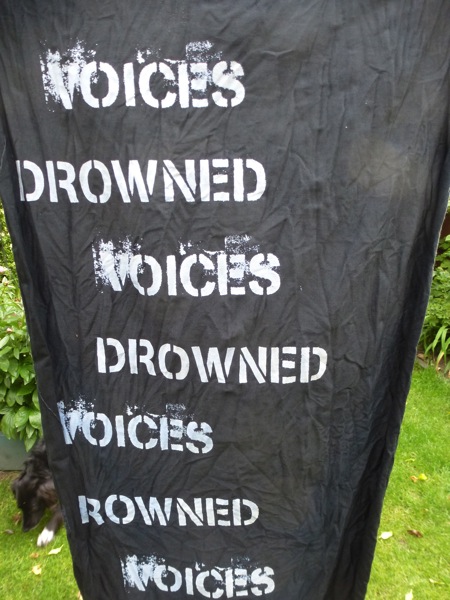
The words again - probably their last outing as I only have one more week in the studio.
The dyeing technique is also called illuminating discharge, and it is possible to do it in one step, but the college has a limited range of colours available so this method gives more scope for mixing our own colours.
These will both be over-dyed next week.  I'll also try this on some of my own dyed cloth - so many possibilities.