Pages

Showing posts with label discharging. Show all posts

Monday, 1 July 2013

Back to quilting's roots

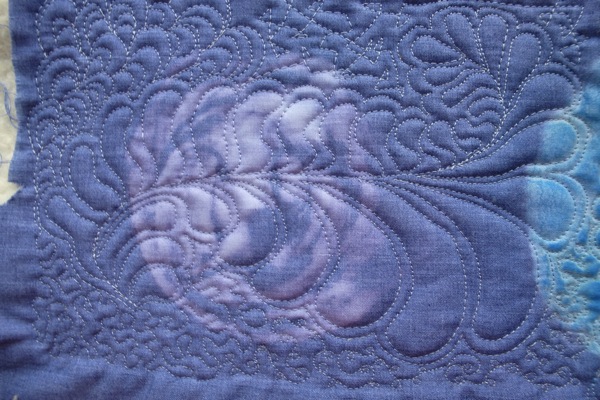
I am drawn ( literally ) to quilting's roots at the moment and have a bit of an obsession going on with freeform feathers.  When I started quilting, these seemed completely unattainable to me.  With the generous on-line help from skilled quilters, particularly Diane Gaudyinski, Sharon Schamber, Leah Day and Patsy Thompson, I've progressed through drawing….

P1010568 

although those right hand plumes look a bit more like segments of a satsuma now, this could be a new trend.

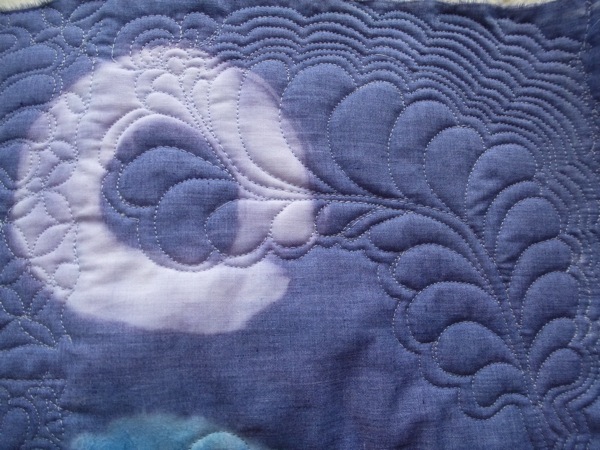
To stitched 6 x 4 samples

P1010559

P1010560

P1010561

P1010566P1010567

These samples were stitched on 80 / 20 wadding, with Bottomline thread in both top and bobbin, and with a 70 needle.  Once I'd got the tension sorted out ( using that finger thing on the Bernina bobbin case that I didn't know why it was there) this was lovely to stitch with.

The white rings were from playing with the dye-discharge method using Milton, then re-inserting colour in to some of them using Artbars

Thursday, 13 June 2013

Discharging…………

……..is a verb that can have several meanings.  At Morley this week and last, we were working with this fabric, and removing the colour with..
NewImage
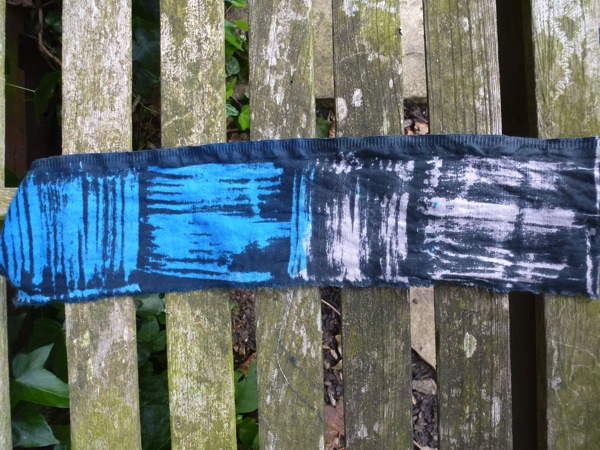
This was astonishingly effective in removing the colour, literally working in front of our eyes.  Using various stamping, dribbling, painting and folding techniques, this gave a grand series of marks on the cloth
P1010322
P1010326
P1010328
P1010330
P1010323
which were then over dyed with Procion p dye paste this week, to colour the areas where the dye had been removed.  The dye was applied in several ways :
  • by scraping it on with a credit card - a strangely compelling and satisfying technique that makes a great sound on the cloth
  • by painting it on with a paint brush
  • by squeezing it on to the cloth with a plastic needle-nosed bottle
P1010324
P1010325
P1010327
P1010329
P1010331
Then we used another discharging agent, Formusol, which can be added to Indulca paste to allow the formusol to be used like a print paste.  This is a bit more fiddly as the cloth has to be steamed to activate the pete, but it seems even more magical as the discharged print is not revealed until the cloth is unrolled after steaming.
P1010332
Discharged circles, made using discs of acrylic, smeared with the paste ( using a foam brush) and then stamped on the cloth.
P1010333
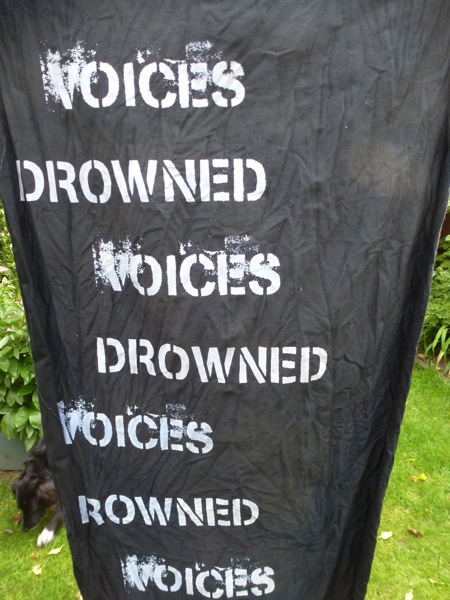
The words again - probably their last outing as I only have one more week in the studio.
The dyeing technique is also called illuminating discharge, and it is possible to do it in one step, but the college has a limited range of colours available so this method gives more scope for mixing our own colours.
These will both be over-dyed next week.  I'll also try this on some of my own dyed cloth - so many possibilities.