Pages

Tuesday, 26 June 2012

Reasons to be cheerful

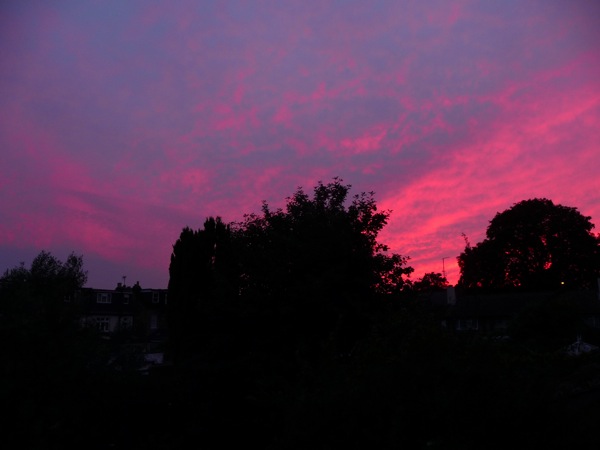
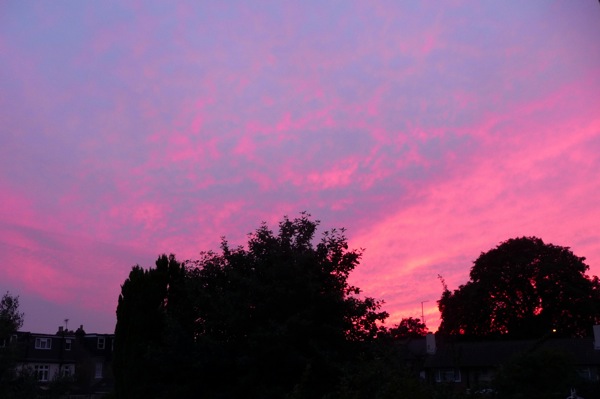
London sunsets.
P1080749.
P1080750.


First loganberries in a favourite bowl.
P1080758

Saturday, 23 June 2012

Accentuating the positive

The week started well, with a visit to "Showstoppers the Musical" on Sunday, but then went downhill with car and work issues, followed by a day in the Morley study full of my own errors trying to do some devoré. All good learning, but I've had to sing a lot of " Accentuate the positive" to keep going.

So a return to some charity sewing,for boys this time, using patterns adapted from hereP1080743

Something positive, and two more pairs cut out.

Saturday, 16 June 2012

Dresses

There are some dresses that always stick in the mind, bringing back vivid memories and strong emotions. Not always those associated with set-piece events such as weddings, but those worn on more everyday occasions. For me these are: a grey and white check, round necked,long sleeved with a red velvet ribbon trim when I was 5; a dirndl skirted cotton number with a large collar, a hand me down from friends of a family friend with America relatives when I was 8; a hand-made, cream, flouncy number for a school dance in my teens; a hand-made, couture effort, Jasper Conran look-a-like in fuchsia pink, lots of darts, large shoulders and brass buttons in my 30s.

Perhaps these memories are why I was stirred to action by this charity sewing project " Dress a Girl Around the World". I avoid many charity sewing projects as they are too dominated by individuals with strong religious views. ( It is perfectly possible to be charitable without this having any religious or dubious spiritual trappings). The UK project is organised by Louise from Sew Scrumptious. I was due to be at a trapunto workshop today, but as it was cancelled due to the tutor being ill, so I got down to finishing these, started at the Bank Holiday weekend.

P1080737.

Very therapeutic, and used up fabric I have had forever. It was lovely adding pockets and trim - as a mother of boys, this has been lacking in my clothes' sewing life. These will be in their way to Louise on Monday.

Thursday, 7 June 2012

But is it art?

P1080708

The boy stands enveloped within the shirt of his father. His and his brother's shirts contained within the billowing boundaries of a shirt of the father and the mother at each end. The plaything discarded on the floor, next to the blanket of warmth, the boy stares away. Enclosed at the boundary of the inner and the outer, this piece symbolises the protection of the family while the young journey from the security of the home, through the vicissitudes of the educational system to the green world that beckons beyond the glass.

Well no………….it is a really wet day and I need to get these shirts dry somehow.

Some contemporary art this week at Ham House has left me interested and baffled in equal measure, and inspires the pretentious piffle at the beginning of this post. Worth a visit, as the house is incredible and the gardens are great to escape into.
P1080692P1080694P1080696P1080691


and these pieces were interesting to me, the first by Ruth Proctor
P1080678

the second by Graeme Miller, called Yewtube ( I always like a good pun) - look very closely in the middle of the lens
P1080681


And then to the lovely Modus embroidery exhibition in Richmond until 16th June. Very small, but some exquisite pieces and worth the trip.


Brenda Fielder
P1080713

Astonishing layers of blanket stitch didn't get the artist's name.
P1080721

A very good aspect of this exhibition is the education / information boards in the first room that set the context of the stitching for visitors who don't have any knowledge of embroidery, this history, threads or modern techniques. There are some historical exhibits from the collection of the Embroiderers' Guild, including a very moving and beautifully stitched sampler book from the Second World War, made by Mrs St Osyth Wood.
Thursday, 31 May 2012

I am still sailing

Last day before half term, and a chance to print up the sails at twice the size, with the Procion P dyes, using more complex mixes of colours. I also wanted to see if it was possible to get an ombre effect with the dyes.

Sails detail, showing some success with the ombre at the far left, although also showing some inconsistent application of the dye paste, making it a bit streaky, particularly in the blue. This is a much finer cotton poplin, and also had an interesting watermark effect left once the dye had dried.
P1080642

Full length, one direction
P1080640

Full length, from opposite direction
P1080644

I love this technique.

Then off to Prism for a meet-up with Morley friends from last year. Well worth the trip if you can make it there by Sunday.


Saturday, 26 May 2012

So, on the hottest day of the year so far, we use the smelliest process in the studio………

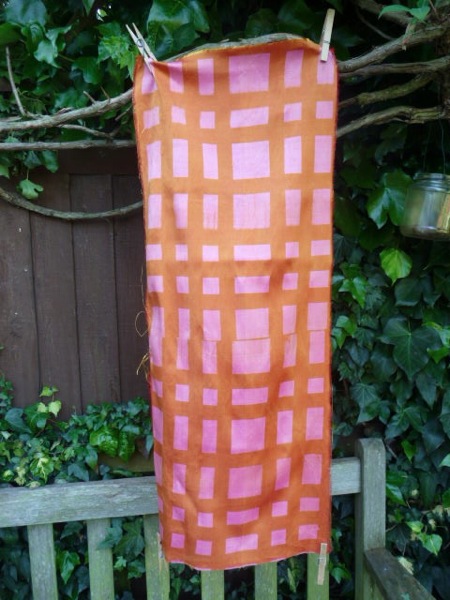
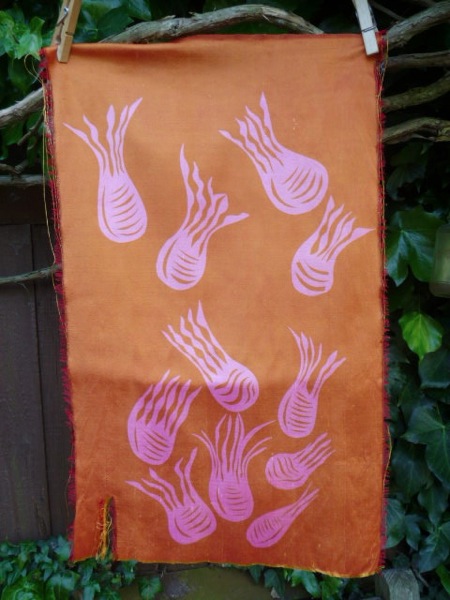
Discharge printing, on fabrics that I have dyed previously and on silks from india that have been stashed away for years. This was also a chance to try out the new screen made with the paper cuts and to repeat a bit of "Charles Rennie Mackintosh meets Frank Lloyd Wright at the Willow Tearooms".
P1080634

The lighter patterns appear solely as a result of the discharge paste being applied through the silk screen. As I didn't dye these silks myself, I had no idea what the result would be. Excitingly, they are all lovely, details below.

Charles Rennie Mackintosh etc, the first on shot silk dupion and then on tightly woven paper silk
P1080625
P1080630
P1080632

Papercuts
P1080627
P1080628
P1080631


Papercuts on dyed, waxed, dyed again cotton
P1080633

The paste has to be activated by steaming, so the studio was baking. All worth it though.


Thursday, 17 May 2012

The sails are printed

From here to a printed length this week. Five separate paper stencils, 5 different mixes of Procion P dye, carried on to the cloth with Manutex paste, ( I can't find an internet link about this method) lots of measuring, and it does approach the initial design.

Detail

P1080588

Detail, showing scale of image

P1080593

Full length of cloth, showing dye testing on the bottom selvedge

P1080587

The advantages of this method are: it doesn't need huge amounts of water; the dyes are very true to their final colours during the printing process; mixing the colours is very straightforward and subtle variations are easily achieved; the overlay of colours is subtle; the hand of the fabric isn't changed.

The disadvantage is that the dyes have to be fixed with steam, which is fine in the studio which has a bullet steamer, but is a bit more unwieldy at home.

Lots of learning in this exercise about working with paper stencils, overlaying colour, measuring up a repeat, managing a long length of fabric. More to come hopefully as I have now cut a set of these shapes at 200% of the original size.